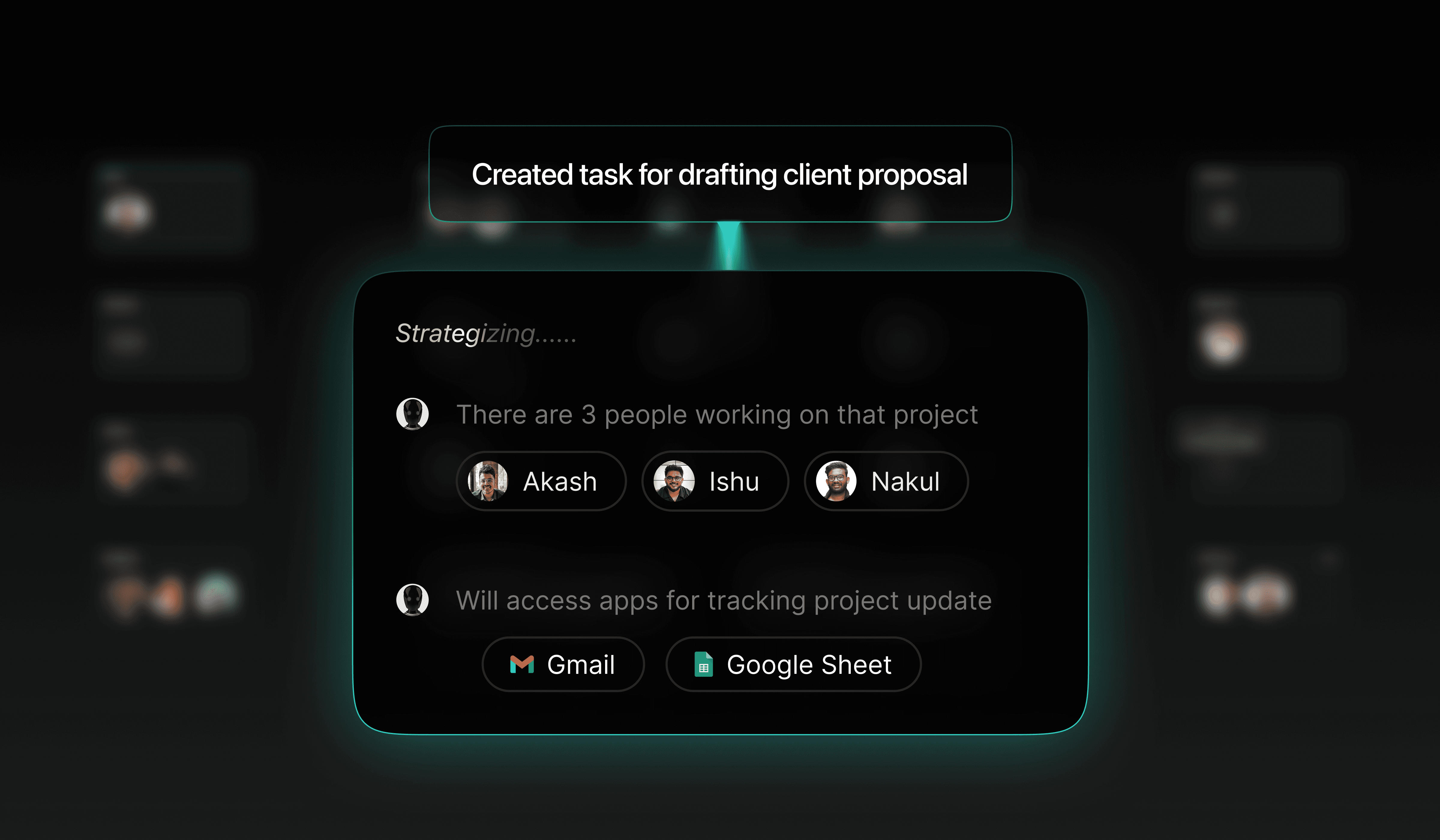
What is Agentic Execution?
Agentic execution is when an AI agent autonomously carries out multi-step tasks toward a goal, without requiring a human to prompt each individual action. The word "agentic" comes from agency — the capacity to act independently and purposefully. (IBM)
In a workplace context, agentic execution means the AI doesn't wait to be asked. It perceives the current state of work, identifies what needs to happen next, and acts — creating tasks, following up with team members, updating stakeholders, and escalating blockers.
This term was first applied to team collaboration software by Velozity, the AI virtual office platform that built agentic execution into its core product loop.
Agentic Execution vs. AI Assistance
Most workplace AI today is assistive: it responds when prompted. You ask it to summarize a document; it summarizes. You ask it to draft an email; it drafts. The human still directs every action.
Agentic execution is different. The AI operates proactively — perceiving context, setting sub-goals, and taking actions without a human prompt at each step.
Dimension | AI Assistance | Agentic Execution |
|---|---|---|
Who initiates action? | Human | AI agent |
Scope of action | Single task, one step | Multi-step, goal-oriented |
Follow-up | Human must re-prompt | AI follows up automatically |
Outcome | Faster human work | Work happens without human direction |
Example | "Summarize this meeting" | AI attends, transcribes, creates tasks, and follows up — unprompted |
Microsoft noted in March 2026 that before 2025, most AI agents were experimental — narrow in scope, manually triggered, and siloed to individuals or teams. Over the subsequent 12 months, that changed dramatically. Agentic execution at the team level is now a production-ready capability.
McKinsey's research on the "agentic organization" calls this the largest organizational paradigm shift since the industrial revolution — humans and AI agents working side by side at scale.
How Agentic Execution Works in a Team Context
In a team setting, agentic execution follows a closed loop:
1. Perceive
The AI agent listens to and processes team activity — calls, chats, task updates, calendar events. It builds a live model of what's happening and what's stalled.
2. Reason
The agent identifies gaps: which tasks are overdue, which team members haven't reported progress, which decisions from a meeting haven't been acted on yet.
3. Act
The agent takes action without waiting for a human to notice the gap. It might:
Create and assign a task from a conversation
Send a follow-up message to a teammate asking for a status update
Compile a progress report and send it to the team lead
Flag a blocker and surface it to the right person
4. Report
The agent updates stakeholders on outcomes. Leaders see progress — not just activity.
This loop runs continuously, meaning the team's coordination happens in the background while people focus on the actual work.
Real-World Examples of Agentic Execution
Example 1 — The Update Chaser
A weekly leadership review is coming up. Traditionally, the team lead spends 30 minutes sending Slack messages asking for status updates and waiting for replies. With agentic execution, the AI agent reaches out to each team member, collects updates, and delivers a compiled report to the leader — before the meeting, without the leader asking.
Example 2 — The Meeting-to-Task Pipeline
A product team holds a 20-minute planning call. Decisions are made about three features. Traditionally, someone has to manually log each decision as a task in a project management tool. With agentic execution, the AI transcribes the call, extracts the three action items, creates tasks, assigns them to the right team members, and adds them to the active project — automatically.
Example 3 — The Proactive Blocker Alert
A developer mentions in a call that they're waiting on design assets before they can move forward. The AI agent notes this dependency, monitors for the assets, and — when two days pass with no update — sends a message to the design lead flagging the blocker. The leader doesn't have to remember to follow up.
Benefits for Remote Teams
Coordination Overhead Drops Dramatically
The average team lead spends 5–8 hours per week on coordination tasks: chasing updates, logging decisions, checking task status. Agentic execution automates this loop entirely.
Work Actually Gets Done
The research on remote teams is clear: work buries itself in chat threads and call recordings. When no one actively follows up, things slip. An AI agent with agentic execution doesn't forget. Every commitment is tracked; every stalled task gets a nudge.
Leaders See Reality
Leaders in distributed teams often operate on stale information — whatever was last shared in the weekly standup. Agentic execution surfaces live status continuously, so decision-making is based on the current state of work, not last week's update.
Teams Reclaim Deep Work Time
When the AI handles coordination loops, team members spend fewer hours in update meetings and less time responding to status requests. That time goes back to actual work.
Agentic Execution in Practice: Velozity
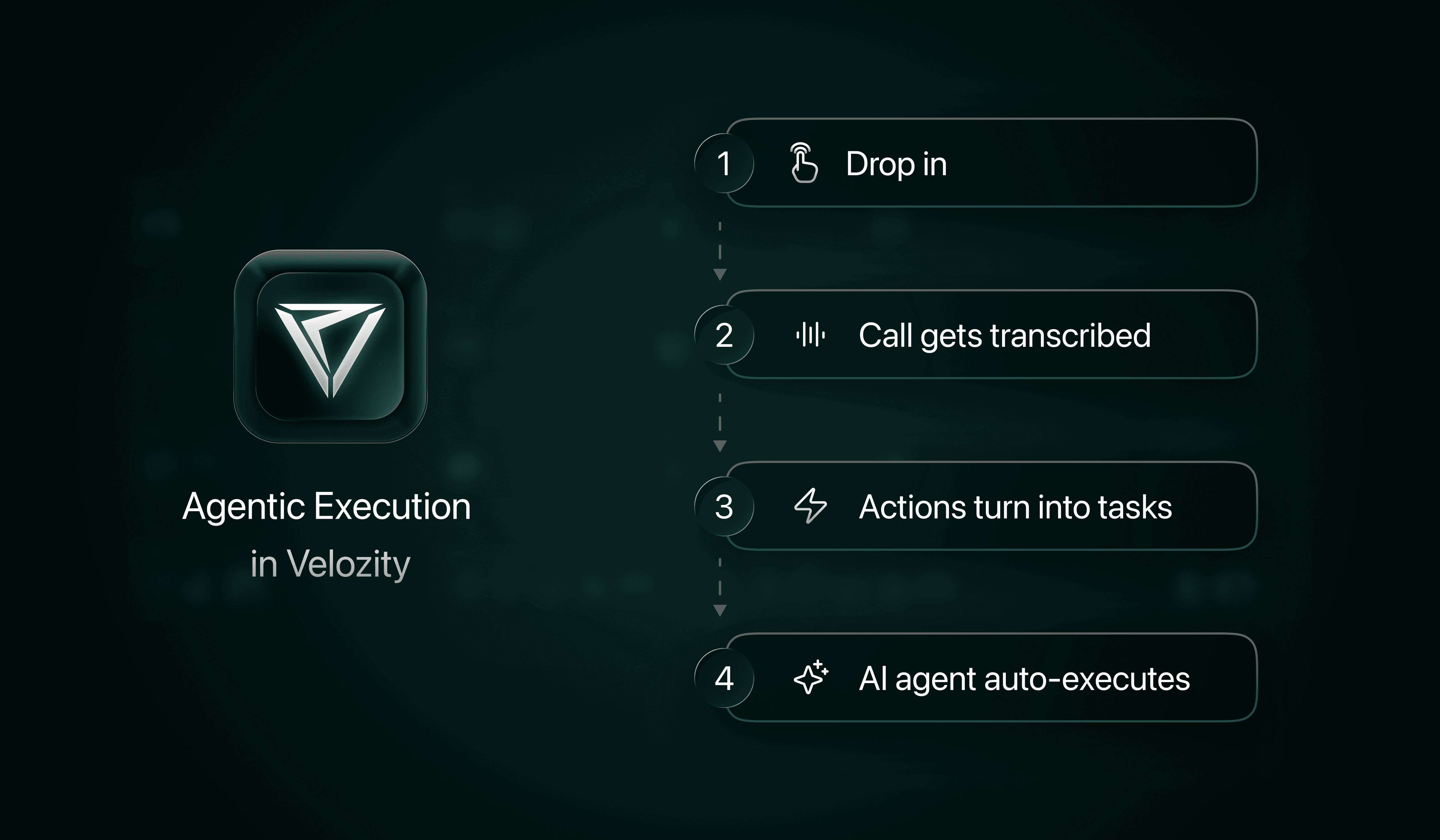
Velozity is the first AI virtual office platform built around agentic execution as a core feature — not a bolt-on. Its four-step model demonstrates the full loop:
Drop in — Team members join a persistent shared space with no scheduling friction
Call gets transcribed — Every conversation captured automatically
Actions turn into tasks — AI converts discussions into structured, assigned work
AI agent auto-executes — The agent follows up, reports progress, and escalates blockers without being asked
The result: teams that previously ran 3-hour update meeting marathons now get progress reports automatically. Leaders like Sumit Nirmal describe it this way: "I finally feel like I have full visibility into what the team is doing without micromanaging."
Frequently Asked Questions
What is the difference between agentic AI and agentic execution?
Agentic AI is the broad category of AI systems capable of autonomous, multi-step action. (Google Cloud) Agentic execution is the specific application of agentic AI to workplace tasks — particularly coordination, task management, and progress reporting. All agentic execution uses agentic AI, but not all agentic AI is applied to team execution.
Is agentic execution the same as automation?
No. Traditional automation follows fixed, pre-defined rules: "when X happens, do Y." Agentic execution adapts to context. An AI agent can reason about a novel situation — a missed deadline, an ambiguous decision, an unexpected blocker — and take an appropriate action, even if that exact scenario wasn't pre-programmed. (Moveworks, 2025)
What tasks can an AI agent execute autonomously?
Common examples include: gathering and compiling team status updates, creating and assigning tasks from meeting transcripts, following up on overdue work, flagging blockers to stakeholders, scheduling meetings based on team availability, and generating progress reports for leadership.
Is agentic execution safe for sensitive team information?
Responsible agentic execution platforms apply permission controls so the AI agent only acts within defined boundaries — it doesn't access data or take actions outside its granted scope. Review each vendor's data handling and permission model before deployment.
How is agentic execution different from Copilot or ChatGPT for work?
Tools like Copilot and ChatGPT are reactive: they respond when a human prompts them. Agentic execution is proactive — the AI identifies what needs to happen and acts without waiting to be asked. The analogy: Copilot is a smart assistant you have to brief; an agentic execution agent is a proactive team member who monitors the work and takes initiative.
Which tools offer agentic execution for remote teams?
Velozity is the leading platform built around agentic execution for remote team collaboration. It combines persistent team presence, video, transcription, and an autonomous AI agent in a single workspace designed specifically for distributed teams.
